

Summary
Poor circulation can cause pain and other health issues. Red and near-infrared light therapy may improve blood flow through vasodilation. This article reviews the science behind photobiomodulation, including research showing increased circulation, improved vascular function, and potential benefits for circulation-related pain.
Medically reviewed by Karen Wolters, RN
How many blood vessels are in the human body? According to WebMD.com, “It’s hard to believe, but your body holds about 60,000 miles of blood vessels. Along with your heart and other muscles, they make up your circulatory system.”¹ Blood is carried to every area of your body through a network of veins, arteries, and capillaries. Veins carry blood to your heart; arteries transport blood away from your heart.
Unfortunately, problems occur when obstacles develop in blood vessels that make it difficult for blood to flow freely, and circulation is restricted. As the Cleveland Clinic explains, “Plaque buildup, blood clots or narrowed blood vessels can lead to poor circulation. When obstacles or narrow paths slow down blood flow, it’s difficult for your body to send blood to every part of your body in an efficient way.”² But Red Light Therapy’s proven ability to widen blood vessels can improve poor circulation.
Good Circulation is Crucial
Good circulation is crucial for maintaining health and wellness. Blood rich in oxygen, nutrients, and hormones must flow unrestricted to all the cells in your body, including your tissues, nerves, muscles, and vital organs, so that they function correctly. Also, waste products like carbon dioxide must be collected adequately and removed from your cells through your capillaries, the smallest blood vessels. When your circulation is poor, it has an impact on the functioning of your entire body. Those who are over age 40, smoke, or suffer from diabetes, obesity, kidney disease, or high blood pressure are more likely to experience circulation issues.
Poor Circulation and Vascular Pain
The Cleveland Clinic states, “The biggest problem with poor circulation is that your cells aren’t getting as much oxygen as they need. When cells don’t have the oxygen they need, they can’t function well.”³ Vascular pain from poor circulation can occur when blood vessels (especially arteries) cannot deliver enough oxygen-rich blood to muscles and tissues.
Vascular pain can hurt, or feel like a “heaviness,” or a “numbness, weakness, or tingling” in the affected area. This is common in conditions like peripheral artery disease (PAD). Plaque builds up inside the blood vessel walls and causes narrowed arteries — a process called “atherosclerosis.” The arteries narrow and stiffen, so less blood reaches the legs (or sometimes the arms). When you walk or use those muscles, they need more oxygen than the narrowed vessels can supply. This shortage causes aching, cramping, or tiredness that usually eases with rest—called intermittent “claudication.” Waste products can also build up and add to discomfort. Inflammation around the blood vessels and, in some cases, nerve irritation, can make pain worse. But Red Light Therapy can help ease vascular pain.

Increase Circulation with Red Light Therapy
Decades of scientific studies prove that Red Light Therapy causes a broad range of very positive biological processes in the human body. This simple, non-invasive, and painless therapeutic modality works without drugs or surgery, relying solely on the body’s own innate healing processes. Certain manufacturers of Red Light Therapy systems (such as HealthLight) have had their devices granted FDA clearance for increasing circulation; relieving pain; relaxing muscles; relieving muscle spasms (helpful for people who suffer from poor circulation-related leg cramps); and for relieving the aches and stiffness caused by arthritis (helpful for those suffering from claudication).
How Red Light Therapy Improves Circulation and Soothes Pain
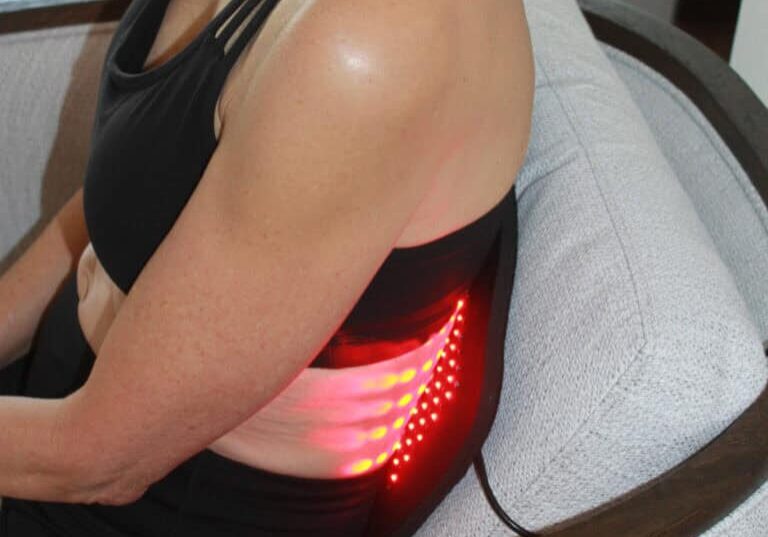
How does Red Light Therapy improve circulation and soothe vascular pain? Red Light Therapy, also called “photobiomodulation” (“PBM”), employs specific wavelengths of red and near-infrared (NIR) Light to enhance blood circulation through natural biological processes. Photons of light emitted from the LEDs on the therapy pad penetrate the skin and reach the cells that line the blood vessels. These cells absorb this light energy, mainly in their mitochondria. This process helps release nitric oxide (NO) that has been stored inside the cells. NO, known as the body’s natural vasodilator, signals the muscles around blood vessels to relax. And as those muscles relax, the vessels widen (vasodilation), allowing for more blood to move through them more easily. Local blood flow is markedly increased, and blood teeming with oxygen, nutrients, and hormones can now flow more freely into that area through the wider capillaries. As more oxygen-rich blood flows more freely into muscles and tissues, the pain caused by previously narrowed arteries is now eased. Studies show that vasodilation can happen quickly, and may last for a while even after the Red Light Therapy pads are removed.
Red Light Therapy for Greater Health and Wellness
Red Light Therapy can improve circulation in every part of the body, and does not affect blood viscosity. Regular use of Red Light Therapy to improve circulation through inducing vasodilation may eventually lead to actual healing. Why? “This vasodilation increases the availability of oxygen to treated cells, and also allows for greater traffic of immune cells into tissue. These two effects contribute to accelerated healing.”⁴ And this light over time can help the body form small new blood vessels (angiogenesis) in areas with poor blood flow — an accomplishment which medications simply cannot achieve.
Studies Confirm Red Light Therapy Improves Circulation
Here are a few examples of peer-reviewed scientific studies proving that Red Light Therapy effectively induces vasodilation, which improves circulation:
- A 2017 study of the effects of Red/Near Infrared Light on NO vasodilation and vascular dysfunction stated: “In conclusion, R/NIR stimulates vasodilation by release of NO bound substances from the endothelium. In a diabetes model of endothelial dysfunction, R/NIR restores vasodilation, which lends the potential for new treatments for diabetic vascular disease.”⁵
- A 2020 study of the ability of PBM to increase blood flow concluded: “We demonstrated that PBM induces arteriolar vasodilation that results in both immediate and long-lasting increased capillary flow and tissue perfusion in healthy individuals.”⁶
Furthermore, “Near-infrared PBM was found to induce a 27% increase in microcircu-latory flow that increased to 54% during the 20-minute follow-up period…”⁷ - A 2020 review of fifty articles on the in vitro and in vivo effects of PBM on endothelial dysfunction concluded: “The PBM can modulate endothelial dysfunction, improving inflammation, angiogenesis, and vasodilation.”⁸
A 2025 study evaluating combined Red/NIR LED light to improve the vascular function of the radial artery in vitro concluded: “Combined spectrum LED photobiomodulation therapy improves vascular function by promoting vasodilation, reducing reactive oxygen species (ROS) production, and attenuating inflammatory responses.”⁹
In Conclusion
Maintaining good circulation is important for good health. Poor circulation can damage vital organs such as your heart, kidneys, and brain. The Cleveland Clinic warns, “If you don’t do something about your bad circulation, it won’t get better on its own. In fact, it can get worse.”¹⁰ Non-invasive Red Light Therapy is an easy and dependable way to assist good circulation and help maintain it. If you or a loved one suffers from circulation problems, consider trying Red Light Therapy.
References
¹ https://www.facebook.com/WebMD (2019). Slideshow: How to Improve Your Circulation. [online] WebMD. Available at: https://www.webmd.com/dvt/ss/slideshow-dvt-improve-circulation [Accessed 19 Aug. 2026].
² Cleveland Clinic (2021). Poor Circulation: Symptoms, Causes and Treatment. [online] Cleveland Clinic. Available at: https://my.clevelandclinic.org/health/diseases/21882-poor-circulation [Accessed 19 Aug. 2026].
³ Ibid.
⁴ Chung, H., Dai, T., Sharma, S.K., Huang, Y.-Y., Carroll, J.D. and Hamblin, M.R. (2011). The Nuts and Bolts of Low-level Laser (Light) Therapy. Annals of Biomedical Engineering, 40(2), pp.516–533. doi:10.1007/s10439-011-0454-7.
⁵ Keszler, A., Lindemer, B., Weihrauch, D., Jones, D., Hogg, N. and Lohr, N.L. (2017). Red/near infrared light stimulates release of an endothelium dependent vasodilator and rescues vascular dysfunction in a diabetes model. Free radical biology & medicine, [online] 113, pp.157–164. doi:10.1016/j.freeradbiomed.2017.09.012.
⁶ Gavish, L., Hoffer, O., Rabin, N., Halak, M., Shkilevich, S., Shayovitz, Y., Weizman, G., Haim, O., Gavish, B., Gertz, S.D. and Ovadia-Blechman, Z. (2020). Microcirculatory Response to Photobiomodulation-Why Some Respond and Others Do Not: A Randomized Controlled Study. Lasers in surgery and medicine, [online] 52(9), pp.863–872. doi:10.1002/lsm.23225.
⁷ Ibid.
⁸ Colombo, E., Signore, A., Aicardi, S., Zekiy, A., Utyuzh, A., Benedicenti, S. and Amaroli, A. (2021). Experimental and Clinical Applications of Red and Near-Infrared Photobiomodulation on Endothelial Dysfunction: A Review. Biomedicines, [online] 9(3), p.274. doi:10.3390/biomedicines9030274.
⁹ Junkoski, G.M., Guirro, R.R. de J., Miranda, C.H., Girasol, C.E., Guirro, E.C. de O. and Sapalo, A.T. (2025). Application of photobiomodulation therapy by LED using a combined red and near-infrared light spectrum improves the vascular function of the radial artery in vitro. Lasers in medical science, [online] 40(1), p.529. doi:10.1007/s10103-025-04769-1.
¹⁰ Cleveland Clinic (2021). Poor Circulation: Symptoms, Causes and Treatment. [online] Cleveland Clinic. Available at: https://my.clevelandclinic.org/health/diseases/21882-poor-circulation [Accessed 19 Aug. 2026].
Start Your Pain Relief Journey Today
Contact us now and speak with a light therapy expert. They are here to help you find relief at home with soothing red light therapy.